Saturday, June 25, 2011

New Home for an Old Idea

This is a short paper prepared for DAARC 2007, but was not presented there. I have yet to find a good home for it, so I guess this is as good a place as any.
Abstract
 Pronouns are a typical realization of Presuming reference in text, but Presuming reference has a range of realizations (Martin, 1992). In order to resolve anaphora in discourse, all instances of Presuming reference first need to be identified. One obstruction to extending resolution of anaphora to realizations beyond pronouns is the influential concept of bridging (Clark, 1977), a type of inference which posits a distinction between direct reference, including pronouns, and indirect reference. This paper outlines objections to bridging, and recommends that semantic relations, including repetition, superordination and composition (e.g. meronymy), better explain referential ties than bridging. This reinterpretation positions anaphora in the system of Presuming reference under the semantic category of repetition. Adopting a centering approach (Strube and Hahn, 1999) within a systemic-functional framework of discourse semantics, the resolution of Presuming reference is enabled by semantic relations. Consequently, anaphora, as realizations of Presuming reference, can be resolved through a range of sense relations. Examples of text analysis are provided with quantitative results. Suggestions for incorporating computational tools such as Word-net demonstrate the applicability of the model to computational implementation.


Thursday, June 23, 2011

Martin & Matthiessen on Genre

Just a quick post for this 11-minute interview which was conducted following this Plenary talk at TESOL 2011:
James R. Martin and Christian Matthiessen
Modelling and Mentoring: Teaching and Learning From Home Through School
Friday, March 18, 2011
8:30 am–9:30 am
Adopting a longitudinal perspective on teaching and learning language from home through school to working life, Martin and Matthiessen bring out the inherent complementarity of teaching and learning processes, showing how parents and teachers serve as mentors for learners by modelling meaning for them in dialogic interaction.

Lots of interesting points, but I do have one criticism - Speak up Jim! We can hardly hear you, and we couldn't get what you were saying in your ISFC plenary. Could you please turn up your volume when in the presence of technology. It does not seem to pick you up very well. Thanks.

Thursday, June 16, 2011

By JOVE!

First there was PLoS, now there is JOVE.

Biological, biomedical, neurological and medical science research has a new outlet. Alongside a paper version of research, JOVE (Journal of Visualized Experiments) publishes an online video version of the research paper.

JOVE is peer-reviewed, open source, Web 2.0 with community feedback and multi-modal. The official description from all JOVE webpages is:
"Journal of Visualized Experiments (JoVE) is an online research journal employing visualization to increase reproducibility and transparency in biological, medical, chemical and physical research."

Could this be the way of the future for academic publishing? Will linguistics researchers and journals be able to follow the lead of the medical sciences? In this great example (Brümmer, V., Schneider, S., Vogt, T., Strüder, H., Carnahan, H., Askew, C. D., Csuhaj, R., Coherence between Brain Cortical Function and Neurocognitive Performance during Changed Gravity Conditions. http://www.jove.com/details.php?id=2670 doi: 10.3791/2670. J Vis Exp. 51 (2011)) from the German Sport University Cologne, you will find a description of the methodology of the experiments, discussion of the results, and brief explanation of how the results can be applied, in addition to watching people fly to zero-gravity to perform tests. You will also watch a little self-promotion by the researchers while doing the CARS* step in the research paper genre. Throughout, however, the level of English is very high, and so we need to ask whether this would be yet another prohibitive measure to non-native speakers when trying to publish academic research. Academics of the future may have to be able to submit publishable English in written form and speak about it to internationally acceptable standards.


*Create A Research Space

Monday, June 6, 2011

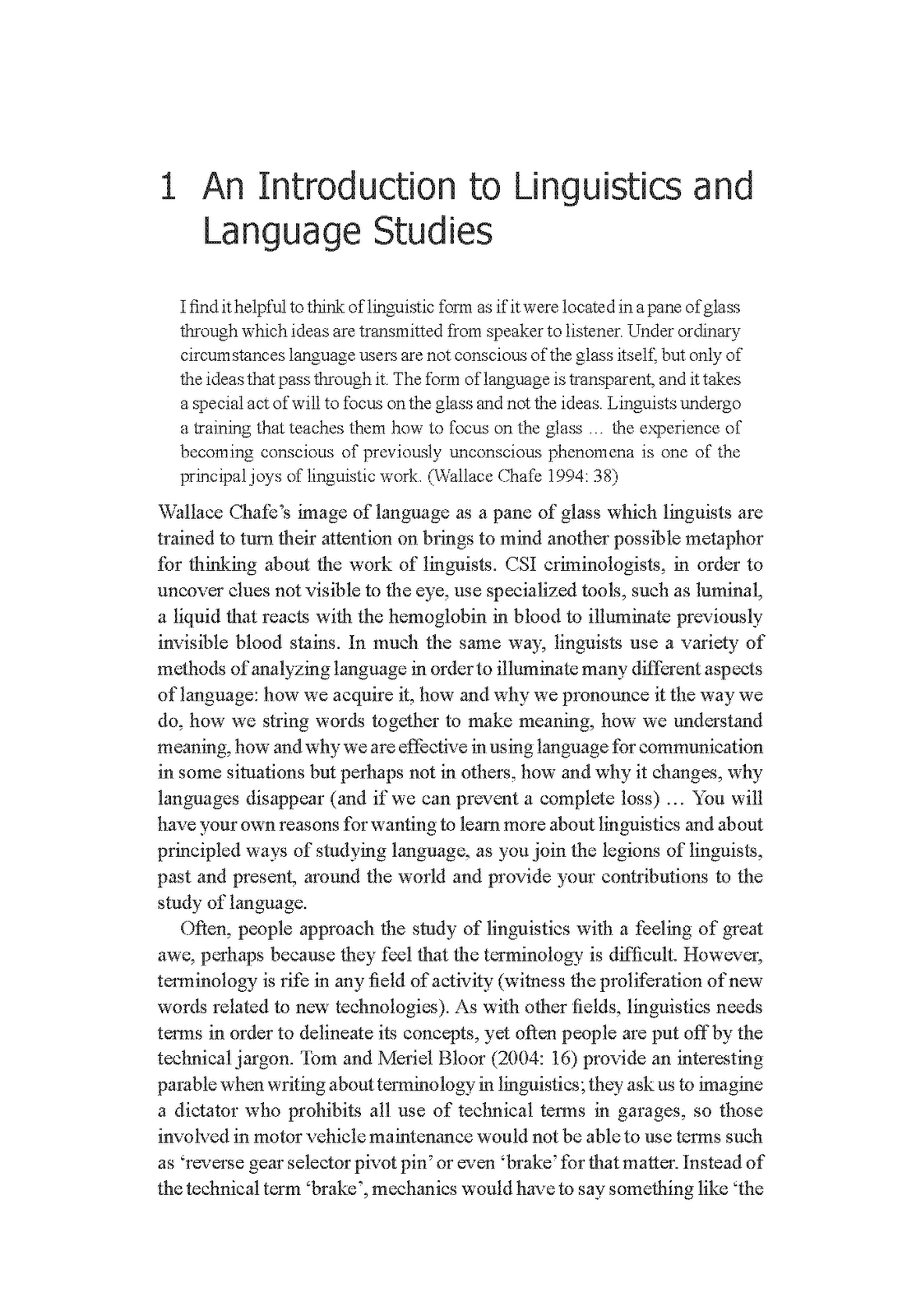
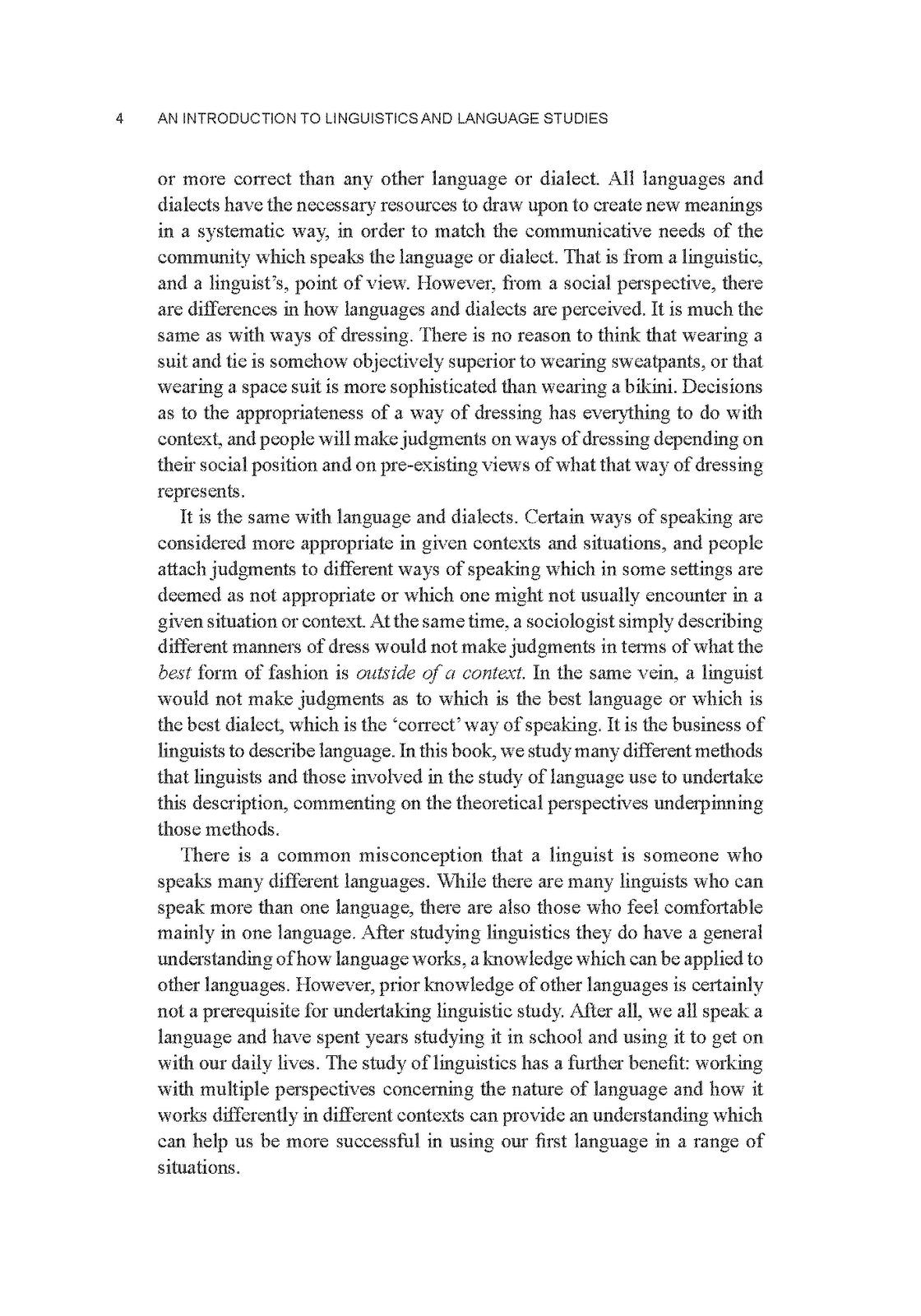
An Introduction to Linguistics and Language Studies

Yey!!
At last an introductory linguistics textbook that takes a clearly functional-linguistic line on all issues, without neglecting all of the important areas of the field. There are lots of well-chosen real-life examples to make the clear text and interesting discussions more relevant to new students of linguistics.
Here's a list of the chapters:
1. An Introduction to Linguistics and Language Studies
2. A Focus on Spoken Interaction
3. Analyzing Written Language
4. Language and Mind
5. Language Change
6. Language Variation
7. Language, Biology and Learning
8. Fields of Linguistics
Chapter 8 is subdivided into 13 areas such as clinical linguistics, computational linguistics and psycholinguistics. I will definitely be looking closely at this book to see if I can use it as my main coursebook for "Introduction to Linguistics" & I suggest that you do, too.
Congratulations to Anne McCabe on a job well done.
I will post a link to the Linguistlist review (& any others) when it is ready.


Go here for the publisher's page

Also from the publisher's page, here is the first chapter (click on each page to enlarge) to give you a taster of the style and the level of the book:

And here's another perspective (from linguistlist).

Sunday, May 15, 2011

Starwarsify Anything

You too can make an entrance as dramatic as a Star Wars film. Get instant inter-textual status. Grab their attention in class or at a conference with the iconic music and grand 'disappearing-into-the-void-of-space' opening titles of Star Wars, using any text that you want. Here's an example, but I'm sure you or your students can do better!
Make your own on the Star Wars site.
I have to admit to being a big Star Wars fan. From the first film in '77 when I sat in the local flea pit nearly every day for a fortnight, I have been hooked on the fantasy and the vision (but not the dialogue, George!!).
Here's another attempt:
and the link.

Thursday, April 14, 2011

1st Words: The Video

What if you were able to record every interaction a child had? What if you were then able to transcribe all those interactions, and then what if you were able to analyse them computationally? These are 'what if' questions no more. Deb Roy of M.I.T. (no less!!) has done precisely that, and more.

In this video from TED Talks, he explains how this happened and talks about some of the results - you can hear his son's speech develop from 'guga' to 'wa'der' for water.

But, it seems that was not enough, because his team then took the tools they developed for this project and applied them to other patterns of interaction, especially examples from mass media communications.
His TEDTalks profile page also provides some useful inks to papers and labs where this work is developed.
Can we finally put the 'poverty of stimulus' argument to bed now thanks to tools such as these, or are we going to have to hear more on language acquisition devices?

Acknowledgment: Thanks to eldon for bringing this topic & video to my attention, Find more on her blog.

Friday, April 1, 2011

READ 2

A big slap on the back to Tom, Gill, Sudeep & myself for the 2nd issue of READ Magazine (ISSN 2221-3740). A lot of great articles from a wide range of contributors, some key advertisers and a whole host of ideas on how to get more people reading more.

This edition has articles from Paul Nation and Rob Hill, from Palestine, UK, USA & UAE. This edition introduces centre page photocopiable resources, and features plenty of Reading Champions.

Just to give you an idea of what the magazine is about, here is an article from Karen Ryan of the British Council in the UAE (click to enlarge).


If you have any articles you want to contribute, or if you think you can help distribute to the right people, take a look here (click to enlarge).

Tuesday, March 15, 2011

Prezi -for Dynamic Presentations

Ok. I am probably way behind on this one, too. But if you are as behind as I am, check out Prezi. It is a lot less static than MS PowerPoint, provides more fluid animation than OpenOffice Impress (which is way ahead of the MS product) and offers a hierarchical approach to presenting ideas that I think most educators would immediately respond to.

As always I have tried it out first, so here is my first attempt which was designed for a lecture in Technical Writing and communication.


The 'deal' is that you either let Prezi.com keep all your work as you work online for free, or you pay USD59 for the option of keeping your online work private, or you pay USD159 to download a desktop version of the programme. A final option - the one that I took - is to download the desktop version for a 30-day trial. This gives full functionality but leaves the Prezi.com logo on all your presentations.

Once again, though, it is probably only when you let your students loose on technology like this that you will learn what it is truly capable of.

Thursday, February 24, 2011

Xtranormal Activity

I recently stumbled upon a great software application that appears to have a lot of language and learning potential. I was sent the following video entitled "One Professor's Fantasy":


It has a few swear words, so be warned if you are a bit squeamish about that kind of thing. There are so many nuggets of truth in there and I have found myself saying, or nearly saying, most of these things. Here's a video I made today loosely based on a conversation from this morning.


So, the question is, how are these videos made? And the answer is 'very simply!' The Xtranormal website allows you to use scenes, characters and background noises to create your own dialogue. You can then change camera angles, add motion, and add various other tricks to help you make a more dynamic animation. All of this is free, but naturally there is a more sophisticated version which you can subscribe to.

I believe there is great potential for language learning here. At its simplest, the animations can be used to replace those very static language presentations on the whiteboard. With just a little Xtra preparation, you can offer your students sound, movement and text. Another approach could be to use the characters as good and bad examples of presenters. Not surprisingly, you will be amazed when you hand over the tools to students and see what language they can produce using these characters.

So it's all great and there are no drawbacks, then. Well, no. There is one HUGE drawback, and that is the computerised voices used to sound out the dialogues - you probably spotted it in the video above. As text-to-speech engines have still not mastered intonation, information structure and good use of pitch and the tonic foot, the speech can sound from mildly to extremely unnatural. Let's hope that this can be fixed in the near future.

Wednesday, February 9, 2011

The Symbolic Species: The Co-evolution of Language and the Brain

by Terrence W. Deacon

In answer to central questions such as "What makes humans different?", "Is it brain size that gives humans speech?", "How did consciousness and language evolve in humans?", and "What is consciousness?", Deacon provides an elegant solution. We are a symbolic species. Language, and as a consequence consciousness, are made possible by the use of an ability to process symbols. I will try to explain how the symbolic process works, why it is important, how it evolved, and what effect it has on consciousness following Deacon's arguments.

Let us make a few important points to start with. The approach here is truly inspirational and revolutionary. This is not a repetition of tired and discredited views of 'language areas of the brain' or the left-right split for thought and language. This book does not spend 450+ pages supporting the tired hackneyed conjecturing of Chomsky, Pinker & their followers. Ever since Chomsky first announced some kind of language acquisition device, more and more physical evidence has been amassed about how the brain functions and is structured to show how misguided the original idea was. Instead of retreating, the Chomsky camp has only tried to obscure this basic belief behind formalisms and frauds. Deacon puts the problem clearly. It is nonsense to talk about brains being specifically designed to cater to language from birth, as if language is fixed and brains change to suit language. Whatever language is, it must have evolved to cater to the proclivities of human brain structures and patterns. Language has evolved to the human brain, not the other way.

The core principle of Deacon's approach is a neo-Piercean symbolism. While a real-life object may have a referent, the referent can quickly become an icon that stands separately from the object itself. In the animal world, alarm calls have a direct relationship between a threat and the sound made by a group of animals. These references rarely become iconic in the way that a pet dog may be able to associate any kind of round object with the sound of 'ball' and behave accordingly. None of these, however, represent the way that humans use language. The extra step that animals do not seem to make is to then re-associate icons with each other in novel combinations to the extent that meaning is derived more from the relationships between icons than between the icon and the original object. That this ability is not beyond animals, in particular bonobos, has been demonstrated by the great work carried out by Sue Savage-Rumbaugh and colleagues at the Great Ape Trust, referred to by Deacon.

The question that we must answer is why humans have come to depend so heavily on symbols. Or, more precisely, what evolutionary advantage did symbolic thinking offer early humans? To answer this question Deacon suggests that to look for the source of humans' unique linguistic abilities we should look at their unique evolutionary adaptations. Fundamentally, human societies are all WRONG for two reasons. The first is that human growth patterns work against survival. At precisely the time that mothers and infants need the most food they are at their most incompetent at foraging and feeding. The only way that the mother and child can be assured of having enough food is to share with others, either with other potential mothers or with the father. Potential mothers must make the symbolic connection between exchanging food in their hand for a promise of assistance when they are in need. Thus reciprocity, a human cultural universal, is a symbolic act - it is an exchange of material goods for a promise. Even animals capable of symbolic reasoning find this a difficult leap to make. A father will only share food if he is certain that the child is carrying their genes - and this leads us to the 2nd reason why human societies should not really work when compared to other animals' responses to the reproduction of an individual's genes. Typically animals will either pair-bond or congregate in exclusive mating groups. That is pair-bonds will have a way of showing other potential mates that they are no longer available for reproduction and may even withdraw from potential contact with other suitors to ensure the continuation of their genes. Outside crowded colonies, this is a typical response for many bird species. The other response is typified by the lion pride. A small number of (often related) males will mate with a 'harem' of females who are then given the responsibility of child-rearing and feeding. Thus, when a new lion takes over the pride he will normally kill all the infant lions so that the lionesses are not spending effort on raising another lion's cubs. The same dilemma of 'wasting' valuable resources on another man's genes faces humans, but the response of human social groupings is 'perverse.' Human groups typically consist of a variety of potential male and female mates. In order to ensure a pair-bond humans must again use a symbolic process to pair-bond: they must promise themselves to each other. Thus another human cultural universal becomes ritualised in the myriad forms of marriage ceremony that exist to announce to the community that a pair bond has been established.

So if Deacon can tie the genesis of language down to the end of Australopithecus and the start of homo habilus, what has happened to language since? Whatever language was at the start, it is no longer. We cannot expect our current linguistic abilities to have appeared in total at once. Deacon suggests that a lot of original language was multi-modal, involving body movements, pitch and volume. All of these aspects of communication are still present, but are often ignored by linguists obsessed with predicate logic. We cannot communicate without moving parts of our bodies and Deacon points out that while the 'words' that we concentrate so hard on are being transferred by speech, prosodic features of language are working hard to provide emotional cues. He then describes how the brain probably works in parallel across the two hemispheres to chunk incoming linguistic information so that while one half works on the segmented sounds that constitute lexis and grammar the other tries to unravel the cues provided by prosody. That is, neither hemisphere is exclusively related to language but the two hemispheres simultaneously process different types of linguistic information - and this can be learned by either side of the brain.

This is a superb book. It is almost impossible to do it justice in any length of review. In fact it is 3 superb books - one on linguistics, one on neurology and one on evolution. No make that 4 - it is also fundamentally an anthropological book. While this is its great strength, it is also what makes it a difficult read for most people. Few others could write this book, and most readers will have background knowledge in one or maybe two of these areas. Alongside Deacon's more typical anthropological interests in culture and language (and more than a passing interest in evolutionary theory), his expertise stretches to neurology and experimental biological anthropology. One might call him a renaissance man, but that probably betrays how narrowly-focused many disciplines and specialities have become as much as it celebrates the breadth of Deacon's knowledge.

View all my reviews at Goodreads.com. Yes, another cut-and-paste from goodreads.com.

See more of Terrence Deacon on this blog entry, visit Terrence Deacon's homepage  and access a great article from PNAS outlining his views.

Saturday, January 15, 2011

All in 1 Vocabulary Site

Tom Cobb

The Compleat Lexical Tutor is a long-standing vocabulary resource that has seen many developments, and remains a great resource for any language teacher. Developed by Tom Cobb, it is everything a teacher can ask for: quick, easy and flexible.

Paul Nation
The basic idea is that you can use the site to develop language learning materials from ANY text that you might have. It relies heavily on Paul Nation's work on the different levels of vocabulary, and even uses an online version of the old reliable 'VocabProfile' programme. This allows you to identify which words in a text belong to the 1st, 2nd or 3rd most frequent 1000 words, or to the Academic Word List. Using this information, the language teacher can then identify which words to focus on when developing exercises for their students. Language teachers will also be happy to hear that the site offers tools for 'instant' exercises and activities using word lists and concordances.

But this site is not just for language teachers. The tools offered will help a wide range of researchers that want help in examining the vocabulary of texts. As well as the VocabProfile, you can also find n-gram and other statistics, concordances, a programme to run priming experiments, and much more - with plenty added every time I visit. Plus, a little digging takes you to a lot more resources from the good work that Tom has been involved in for some time. Highly recommended. Keep up the good work Tom.

Sunday, January 9, 2011

A Little Mae West


Mae West, actor & writer
If you could have such a thing!

Here are a few choice quotes* from the woman who put sass into equality, inspired even Dali (right) & created an intonation pattern all her own (even when she sang - try the player below).
“I speak two languages, Body and English.”
“Opportunity knocks for every man, but you have to give a woman a ring.”
“When choosing between two evils, I always like to try the one I've never tried before.”
“When women go wrong, men go right after them."
Mae West by Salvador Dali

Mae West - Come Up And See Me Sometime
Found at abmp3 search engine
*Acknowledgment: http://en.thinkexist.com/

Computational Linguistics - for free!!

Hats off to Association for Computational Linguistics (ACL) & MIT Press for making the excellent journal Computational Linguistics FREE!

That's right. You heard right. It's free. Under the banner of an Open Access Journal, and thanks to the support of the ACL, you can now access a lot of groundbreaking articles from the 'noughties' whenever, wherever via your internet-connected device of choice. (For more on ACL's commitment to Open Access for proceedings and journals see the ACL Anthology.)

Below are a few mouth-watering samples from areas that interest me to get you browsing. In just a few minutes you should find something that relates to your field, and you can be sure of the highest standards of work.
Volume 36, Issue 4 - December 2010

Obituary


Fred Jelinek
Mark Liberman
Computational Linguistics December 2010, Vol. 36, No. 4: 595–599.

ACL Lifetime Achievement Award
The Right Tools: Reflections on Computation and Language
William A. Woods
Computational Linguistics December 2010, Vol. 36, No. 4: 601–630.

Squibs
An Asymptotic Model for the English Hapax/Vocabulary Ratio
Fan Fengxiang
Computational Linguistics December 2010, Vol. 36, No. 4: 631–637.

On Paraphrase and Coreference
Marta Recasens, Marta Vila
Computational Linguistics December 2010, Vol. 36, No. 4: 639–647.

Articles
String-to-Dependency Statistical Machine Translation
Libin Shen, Jinxi Xu, Ralph Weischedel
Computational Linguistics December 2010, Vol. 36, No. 4: 649–671.

Distributional Memory: A General Framework for Corpus-Based Semantics
Marco Baroni, Alessandro Lenci
Computational Linguistics December 2010, Vol. 36, No. 4: 673–721.

A Flexible, Corpus-Driven Model of Regular and Inverse Selectional Preferences
Katrin Erk, Sebastian Padó, Ulrike Padó
Computational Linguistics December 2010, Vol. 36, No. 4: 723–763.

Book Review

Introduction to Linguistic Annotation and Text Analytics Graham Wilcock (University of Helsinki) Princeton, NJ: Morgan & Claypool (Synthesis Lectures on Human Language Technologies, edited by Graeme Hirst, volume 2, No. 1), 2009, x+149 pp; paperbound, ISBN 978-1-59829-738-6, $40.00; ebook, ISBN 978-1-59829-739-3, $30.00 or by subscription
Udo Hahn
Computational Linguistics December 2010, Vol. 36, No. 4: 765–766.

Natural Language Processing with Python Steven Bird, Ewan Klein, and Edward Loper (University of Melbourne, University of Edinburgh, and BBN Technologies) Sebastopol, CA: O'Reilly Media, 2009, xx+482 pp; paperbound, ISBN 978-0-596-51649-9, $44.99; on-line free of charge at nltk.org/book
Michael Elhadad
Computational Linguistics December 2010, Vol. 36, No. 4: 767–771.

Statistical Machine Translation Philipp Koehn (University of Edinburgh) Cambridge University Press, 2010, xii+433 pp; ISBN 978-0-521-87415-1, $60.00
Colin Cherry
Computational Linguistics December 2010, Vol. 36, No. 4: 773–776.

Introduction to Chinese Natural Language Processing Kam-Fai Wong, Wenjie Li, Ruifeng Xu, and Zheng-sheng Zhang (Chinese University of Hong Kong, Hong Kong Polytechnic University, City University of Hong Kong, and San Diego State University) Princeton, NJ: Morgan & Claypool (Synthesis Lectures on Human Language Technologies, edited by Graeme Hirst, volume 4), 2010, x+148 pp; paperbound, ISBN 978-1-59829-932-8, $40.00; e-book, ISBN 978-1-59829-933-5, $30.00 or by subscription
Min Zhang
Computational Linguistics December 2010, Vol. 36, No. 4: 777–780.

Spoken Dialogue Systems Kristiina Jokinen and Michael McTear (University of Helsinki, University of Ulster) Princeton, NJ: Morgan & Claypool (Synthesis Lectures on Language Technologies, edited by Graeme Hirst, volume 5), 2009, xiv+151pp; paperback, ISBN 978-1-59829-599-3, $40.00; ebook, ISBN 978-1-59829-600-6, doi 10.2200/S00204ED1V01Y200910HLT005, $30.00 or by subscription
Mary Ellen Foster
Computational Linguistics December 2010, Vol. 36, No. 4: 781–783.

Machine-Aided Linguistic Discovery: An Introduction and Some Examples Vladimir Pericliev (Bulgarian Academy of Sciences) London: Equinox, 2010, ix+330 pp; hardbound, ISBN 978-1-84553-660-2, $90.00, £60.00
Eric J. M. Smith
Computational Linguistics December 2010, Vol. 36, No. 4: 785–787.

Briefly Noted
Essential Programming for Linguistics
Martin Weisser
Computational Linguistics December 2010, Vol. 36, No. 4: 789–789.

Commentary and Discussion
A Response to Richard Sproat on Random Systems, Writing, and Entropy
Rob Lee, Philip Jonathan, Pauline Ziman
Computational Linguistics December 2010, Vol. 36, No. 4: 791–794.

Entropy, the Indus Script, and Language:A Reply to R. Sproat
Rajesh P. N. Rao, Nisha Yadav, Mayank N. Vahia, Hrishikesh Joglekar, Ronojoy Adhikari, Iravatham Mahadevan
Computational Linguistics December 2010, Vol. 36, No. 4: 795–805.

Reply to Rao et al. and Lee et al.
Richard Sproat
Computational Linguistics December 2010, Vol. 36, No. 4: 807–816.

Last Words
Are We Near the End of the Journal?
Nat Lang
Computational Linguistics December 2010, Vol. 36, No. 4: 817–821.

Reviewers
Reviewers for Volume 36
Computational Linguistics December 2010, Vol. 36, No. 4: 823–823.

Tuesday, January 4, 2011

ISFC Plenary - Jim Martin

In this next installment of plenary speakers at the International System Functional Congress, held at UBC, Canada, Jim Martin delves deep into the assumptions behind different theories of the schools in systemic functional linguistics. Contrary to the expectations of most that consider SFL to be a unified theory that entertains different 'dialects', Professor Martin suggests that the schools are now so far apart in how they view the paradgmatic and syntagmatic axes that there is very little common ground left.


J. R. Martin: Metalinguistic Divergence: Axial Argumentation in SFL


This session was delivered on Friday July 23rd. Unfortunately, the microphone does not pick up everything Jim is saying very clearly and at times you have to strain to hear what he says.

Monday, December 20, 2010

Google Corpus

A new corpus tool has been announced by Google, as reported in this NYTimes article. This represents a 500 billion-word corpus (yes, you read it right) of written English taken from a selection of their scanned books published in the 200 years between 1800 and 2000. The corpus allows for varieties of British and American English, or all varieties, as well as a selection of publications in other languages.

The researchers that developed the resource have enabled online searching of words & n-grams on a dedicated Google website. The website provides handy graphical comparisons of relative frequency over time, which can include combinations of words or phrases (n-grams). The example here compares common quantifying expressions. Links are then provided to 'search for' your word/phrase in Google books, making an instant web-concordance.

If that is not enough for you, you can also download the datasets from Googlelabs. These provide the already analysed relative frequency and distribution of strings, although both OpenOffice & MSOffice are unable to open the enormous files.

Two things that have struck me as surprising with the announcement of this resource are the reaction by some linguists and the approach taken by some of the principle researchers. In the NYTimes article, "Alan Brinkley, the former provost at Columbia and a professor of American history, said it was too early to tell what the impact of word and phrase searches would be. “I could imagine lots of interesting uses, I just don’t know enough about what they’re trying to do statistically,” he said."Admittedly this is a historian rather than a linguist talking, but the project should not be a surprise to anyone who has been involved in corpus linguistics for the last 20 years. The ever-increasing size of corpora, and access to the internet as a corpus in itself, have inspired projects such as webcorp (and see this special edition of Computational Linguistics from 2003). Also, the article reporting the project (available from Science with a free subscription) describes what n-grams are and what they do. The statistical background to n-grams is not hard to find. Also surprising is the inclusion of Steven Pinker, not just in the NYTimes story but also on the list of authors. He claims an interest in language change, but neglects to point out that access to vast amounts of language data is dramatically eating away at his many claims for an innate language. Real evidence of language use and acquisition suggest ever more strongly that language emerges as a result of constant meaningful interaction with the environment (more of that on another post).

The other surprising response is that the principle researchers make fairly exaggerated claims about culture based on the change in patterns of frequency of use that the data reveals. Clearly patterns of use will change over time (and 200 years is still only a snapshot for many words), but claiming to have invented a new subject - "culturomics" - is probably taking things too far.

Tuesday, October 26, 2010

ISFC Plenary - Christian Matthiessen

Here is the next in the series of Plenary talks from the 37th ISFC in UBC, Vancouver. The conference theme, Language Evolving, is explored in phylogenetic terms, here, by Christian Matthiessen.


Rather than me attempting to explain, let Christan do so. This is the abstract for the talk.

Language evolving: Notes towards a semiotic history of humanity

The theme of this International Systemic Functional Congress is "language evolving". This can be interpreted either very generally or more technically.

(1) Taken very generally, this could mean language changing in any of the three time-frames that have been explored in systemic functional linguistics (see e.g. Halliday & Matthiessen, 1999) - phylogenetic change (language changing in the human species, or in human societies, over a long period of time ranging from generations to history of the human species), ontogenetic change (language changing in human individuals [seen as organisms or as persons] in the course of a lifetime, or logogenetic change (language changing in the course of the unfolding of text).

(2) Taken more technically (i.e. with "evolution" in the technical sense introduced by Darwin), this means language changing phylogenetically (cf. Halliday, 1995; Matthiessen, 2004) - language evolving as part of the evolution of the human species (in biological terms) and as part of the evolution of human groups (in social terms), these two being complementary aspects of human evolution.

Here I will focus on the narrower, technical sense of "language evolving". More specifically, I will explore the "big history" of humans (cf. Christian, 2004) - a deep time view of human evolution in linguistic, or more generally in semiotic terms, starting with the emergence of the human line and moving up to the present.

This will mean combining accounts of different time frames in the evolution of language (cf. Figure 1) that have tended to be treated in isolation from one another by different groups of scholars - e.g. the evolution of modern language is explored by linguists, anthropologists, palaeontologists and neuroscientists, but the much more recent evolution of our current language families is studied by historical linguists using comparative methods and the even more recent evolution of particular languages by historical linguists using the methods of philology and (nowadays) of corpus linguistics, although studies based on texts selected to show the emergence of new registers (e.g. Halliday, 1988; Gunnarson, 1993; Nanri, 1993) are still fairly rare.

At the same time, it will also mean supplementing historical accounts that are based on social considerations (including economic factors) but which background human semo-history. A sweeping history such as Christian's (2004) account is a very important contribution but while he recognizes the significance of the emergence of language, he does not build an account of the evolution of language into his history. There have of course been linguistic histories of important periods of human evolution. One recent valuable contribution is Ostler (2005), but he focuses on "major" languages such as Latin, Ancient Greek, Sanskrit, English and Spanish - major in the sense of languages seen as important in world history (languages of "empires"), and "minor" languages are a crucial part of the picture even though (or especially because) many of them are now in danger of disappearing together with their speech communities (see e.g. Nettle & Romaine, 2002; Harrison, 2007). In other words, we have to focus not only on language growth but also on language shrinkage; both are key aspects of human history.

evolution_of_languages-03

Figure 1: Time frames in the evolution of language and humans

In trying to work towards a holistic history of human evolution, I can obviously only make certain observations that will guide the development of a more detailed account. One key principle is that human evolution must be investigated multi-systemically, using an ordered typology of systems - physically (1st order systems), biologically (2nd order systems), socially (3rd order systems) and semiotically (4th order systems; cf. Halliday & Matthiessen, 1999). In the course of human evolution, the emergence of Homo sapiens sapiens was almost surely a key transition. Homo sapiens sapiens has been called Anatomically Modern Humans (AMHs), but I believe that they were also Linguistically (or Semiotically) Modern Humans (LMHs, or SMHs). Some time - up to 100 K years before the present - after the emergence of AMHs, we see clear evidence of the acceleration of human evolution (common associated with the Upper Paleolithic). This acceleration can be interpreted as a shift from lower orders of evolution to higher orders - from primarily biological evolution to primarily socio-semiotic evolution. This is obviously a matter of degree; but the point is that once AMHs / LMHs had emerged, the scene was set for social and semiotic evolution to take over as the primary levels of evolution, and socio-semiotic evolution is much faster than biological evolution, so the evolution gradually accelerated to today's dizzying pace (cf. Delsemme, 1998).

Drawing on Hallliday's (e.g. 1975) account of ontogenesis, we can postulate a model of the evolution of language in three phases, as shown in Figure 1:

  • Phase I - evolution of protolanguage: this phase must have started many millions of years ago, long before the emergence of the hominid line;
  • Phase II -evolution of pre-modern language: this phase will have started with the first "burst" in the evolution of the human brain, probably around 2.2 million years ago (Homo habilis);
  • Phase III - evolution of modern language: this phase will have begun with the emergence of modern humans, Homo sapiens sapiens.

Since around 200 to 150 K years before the present, all linguistic evolution has been Phase III evolution. During this period, there is thus a huge gap between the emergence of modern language (metafunctional and multistratal in organization) and time around 8 K to 10 K years ago when the methods of historical linguistics enable us to identify the protolanguages of the language families currently accepted in historical linguistics (thus excluding putative more ancient groupings such as Nostratic; cf. Ruhlen, 1994). Phase III evolution can be interpreted in registerial terms as an ongoing evolution of the registerial make-up of particular languages together with the ongoing evolution of the contexts in which registers operate (cf. Halliday, 1988; Rose, 2005; Nanri, 1993).

References

Christian, David. 2004. Maps of time: an introduction to big history. Berkeley, Los Angeles & London: University of California Press.

Delsemme, Armand. 1998. Our cosmic origins: from the Big Bang to the emergence of life and intelligence. Cambridge: Cambridge University Press.

Gunnarsson, Britt-Louise. 1993. "Pragmatic and macrothematic patterns in science and popular science: A diachronic study of articles from three fields." In Mohsen Ghadessy (ed.): Register Analysis: Theory and Practice. London & New York: Pinter. 165-179.

Halliday, M.A.K. 1975. Learning how to mean. London: Edward Arnold. Reprinted in M.A.K. Halliday (2003), The language of early childhood, Volume 4 of The collected works of M.A.K. Halliday edited by Jonathan J. Webster. London & New York: Continuum.

Halliday, M.A.K. 1988. "On the language of physical science." In Mohsen Ghadessy (ed.), Registers of Written English: situational factors and linguistic features. London & New York: Pinter Publishers. 162-178.

Halliday, M.A.K. 1995. "On language in relation to the evolution of human consciousness." In Sture Allén (ed.), Of thoughts and words: proceedings of Nobel Symposium 92 "The relation between language and mind", Stockholm, 8-12 August 1994. Singapore, River Edge N.J. & London: Imperial College Press. 45-84.

Halliday, M.A.K. & Christian M.I.M. Matthiessen. 1999. Construing experience through meaning: a language-based approach to cognition. London: Cassell.

Harrison, K. David. 2007. When languages die: the extinction of the world's languages and the erosion of human knowledge. Oxford: Oxford University Press.

Matthiessen, Christian M.I.M. 2004. "The evolution of language: a systemic functional exploration of phylogenetic phases." In Geoff Williams & Annabelle Lukin (eds.), Language development: functional perspectives on evolution and ontogenesis. London: Continuum. 45-90.

Nanri, Keizo. 1993. An attempt to synthesize two systemic contextual theories through the investigation of the process of the evolution of the discourse semantic structure of the newspaper reporting article. University of Sydney: Ph.D. thesis.

Nettle, Daniel & Suzanne Romaine. 2000. Vanishing voices: the extinction of the world's languages. Oxford: Oxford University Press.

Ostler, Nicholas. 2005. Empires of the word: a language history of the world. London: HarperCollins.

Rose, David. 2005. "Narrative and the origins of discourse: construing experience in stories around the world." Australian Review of Applied Linguistics 19: 151-173.

Ruhlen, Merritt. 1994. On the origin of languages: studies in linguistic taxonomy. Stanford, CA: Stanford University Press.

Thursday, October 14, 2010

Constructivist Foundations

I have to recommend the journal Constructivist Foundations, edited and maintained by Alex Riegler.

You will find contributions from von Glaserfield, Varela and many others discussing (radical) constructivism, practical realism, pedagogical constructivism, similarities and differences with other philosophical perspectives, among many others.

These approaches offer an alternative philosophical foundation to the cartesian representationist approaches that underpin many cognitivist models of consciousness. A lot of the contributors have a deep interest in the role that language plays in construing our understanding of the world.

The journal is peer-reviewed and of a very high standard, but FREE! All you need to do is register with an email address to gain access to pdf versions of individual papers as well as whole issues.

Click on the cover (Vol.5 No.3) to go to the homepage, and subscribe for free to access current & archived issues and sign up for email alerts for new issues.

ISFC Plenary - Michael Halliday

The 37th International Systemic Functional Congress was hosted by Geoff Williams at The University of British Columbia, Vancouver, BC, Canada in July 2010.

Thanks to Geoff and the team at UBC, we can all see the videos of the plenary sessions, as well as downloading the presentations slides. (During the conference, they also set up chat rooms for remote participation in the sessions.)

This talk is by the 'father' of systemic functional linguistics (SFL) - Michael Halliday (see de Beaugrande's extensive description). Halliday focuses on the way that SFL includes, quite naturally, an evolutionary perspective.


Michael Halliday - Language Evolving: Some systemic functional reflections on the history of meaning
Talk given at 37th ISFC, UBC, Vancouver, 19 July 2010

This talk is fascinating in that it covers not only major aspects of SFL theory and application to evolutionary theory, including language viewed from ontogenetic, phylogenetic and logogenetic perspectives, but also anecdotes, asides and insights from Halliday himself.

Tuesday, October 5, 2010

ISFC Plenary - Terrance Deacon

The 37th International Systemic Functional Congress was hosted by Geoff Williams at The University of British Columbia, Vancouver, BC, Canada in July 2010.

Unfortunately I was not able to attend the conference, as I was working. However, thanks to Geoff and the team at UBC, we can all see the videos of the plenary sessions, as well as downloading the presentations slides. (During the conference, they also set up chat rooms for remote participation in the sessions.)

I will add the plenary videos to this blog, one by one. The first is by a non-linguist (he's an anthropologist), and so a non-systemicist. However, what Terrance Deacon had to say about the evolution of language was music to the ears of people involved in systemic functional linguistics.


Terrance Deacon - Language and complexity: Evolution inside out
Talk given at 37th ISFC, UBC, Vancouver, 20 July 2010

In this fascinating talk, Deacon develops his thesis that humans are a Symbolic Species by noting that all species are effected genetically as they become domesticated. Domestication produces genetic 'degradation' in that many of the functions previously carried out instinctively become transmitted through our social ecosystems rather than through genetic transmission - what was instinctive becomes learned. He concludes by saying that even if God had come down and given homo erectus an innate language gene - or Universal Grammar - by now, as a result of domestication, that gene would have degraded.

The ERF

Who likes to read - for fun, or pleasure? Who likes to learn a foreign language while reading - for fun or pleasure - in that language? It seems not many of us, and the numbers are dwindling. That is why the Extensive Reading Foundation has been set up.

Headed by ESL luminaries such as Richard R Day, Rob Waring, Anne Burns, Averil Coxhead, Alan Maley, Paul Nation, David R Hill and many others, "The Extensive Reading Foundation is a not-for-profit, charitable organization whose purpose is to support and promote extensive reading. One Foundation initiative is the annual Language Learner Literature Award for the best new works in English. Another is maintaining a bibliography of research on extensive reading. The Foundation is also interested in helping educational institutions set up extensive reading programs through grants that fund the purchase of books and other reading material." (from the ERF homepage)

ERF has just announced its First World Congress for September 2011, and you can follow their blog for all the latest developments in helping the world to read.

Tuesday, April 13, 2010

Construing Experience

Can you experience without language? Certainly. But can you make any sense of your experience without language? Language enables us to construe experience, to make meaning of the stream of experience that is our journey through life. Language helps to divide experience into categories which, through experience and socialisation, become recognisable to the extent that they seem natural. It must be pointed out that these categories do not exist 'out there'. The categories that we use to make meaning are those that have developed within our communities. They seem natural because they are the categories we use to make meaning in every interaction with our environment, including interactions with everyone else who is doing the same thing.
(another lazy cut&paste from my Goodreads.com page)

To learn more about this great book through carefully selected and categorized quotations look at Chris Cleirigh's "sys-fun" pages. Here is a very good example.
"Language is set apart, however, as the prototypical semiotic system, on a variety of different grounds: it is the only one that evolved specifically as a semiotic system; it is the one semiotic into which all others can be “translated”; and it is the one whereby the human species as a whole, and each individual member of that species, construes experience and constructs a social order. In this last respect, all other semiotic systems are derivative: they have meaning potential only by reference to models of experience, and forms of social relationship, that have already been established in language. It is this that justifies us in taking language as the prototype of systems of meaning." Halliday & Matthiessen (1999: 509-10).
That is, we can make meaning through a variety of modes (visual, including photography, graphic design and visual art, aural, including music, and others) and as a result of a register variation (either through natural language - academic text, scientific jargon or air traffic controllers instructions - or through semiotic systems derived from natural language, particularly mathematics), but only because we can mediate their meaning through language.

Wednesday, April 7, 2010

Bonobo 101 - TED Talk by SSR

In this 'trailer' for her work Sue Savage-Rumbaugh explores some of the most significant findings of the pan-species experiments that she has been involved in. She begins by debunking the belief that language is biologically 'hard-wired' into our brains, and offers compelling evidence for the importance of culture in ensuing the development and continuation of art, tool-use and language.

Savage-Rumbaugh's work on developing a human-bonobo culture that encourages both species to learn from each other has been documented in an amazing variety of sources. She has also made significant contributions to the Great Ape Trust. I found one book in particular to be a fascinating study of how man and ape may be considered as sharing a great deal of communicative skills.

Wednesday, March 17, 2010

Black Cat Readers


The place I work at (Khalifa University) hosted a presentation by Rob Hill, a leading author at Black Cat Publishers.

The presentation was a very 'live' version of the advice Rob gives in his useful "The Black Cat Guide to Graded Readers" available on the Black Cat Website

I am very impressed by the Black Cat catalogue of graded readers. When you look at the Black Cat website you will find a range of titles which you can preview. All of the titles that I checked included "dossier" pages which provide factual contextual background on the stories which range from Shakespeare and traditional fairy tales to modern high-tech thrillers. Young boys in particular like to read non-fiction, and so adding factual information that contextualises the stories should help to keep their interest. The Teacher's Corner also includes lots of extra material to help introduce readers into the classroom.

Sunday, March 14, 2010

TESOL Arabia READ SiG

It's that time of the year again. In this neck of the woods, in the UAE, March spells the return not only of the annual TESOL Arabia conference, but all the hoopla that goes with it. As a range of authors, experts and assorted academics are in town for the weekend, the world and his wife want a piece of the action.

The conference this year was just like most years, except more so. That is, disappointing, although this year the venue was the biggest culprit.

This year, however, I am glad to say that the READ Sig was launched, and seems to have generated a lot of interest. The sessions provided by Tom Le Seelleur were mainly well attended and provided a good springboard for the campaign to get the UAE reading. In addition, we have both been very busy preparing the inaugural issue of the magazine for the organisation, called "READ" (big surprise, there!!).

READ Magazine Issue 1 contains articles by Sheikha Bodour Al Qasimi, publisher and daughter of the leader of the Sharjah emirate, who describes how she reads to her children, Isobel Abdulhoul, previously head of Marudy's bookstores and now curator of the Emirates International Festival of Literature, commenting on the importance of literature, authors Peter Viney, Philip Prowse and Caroline Brandt along with a host of talented and committed teachers, librarians and educators who all explain how they are working to raise the profile of reading across the country.

Sunday, February 28, 2010

Interactive IPA

Hands up who loves the IPA (International Phonetic Alphabet)? Maybe not many outside the phonetics and phonology specialisations. It probably isn't my favourite part of linguistics either. All those difficult names to remember related to teeth and lips, tongue and throat.


I am very jealous of people who are learning the IPA in the computer age. No more are linguistics students required to sit alone making absurd noises and imagining they can see clearly the difference between a close-mid front and an open-mid front vowel sound. It isn't that we can't all hear the difference, it is just that it is really hard to feel it. Newcomers to the IPA can now have clearly pronounced interactive charts that clearly show how the sounds are made and the differences between them.

I came across the first one looking at extra pages from O'Grady et al.'s "Contemporary Linguistics". I think they took the idea from Paul Meier and Eric Armstrong. All you have to do is click on a chart which offers explanations by pointing the mouse at the different terms. Then click on a phonetic symbol to hear how it sounds.

I found another version prepared by the good people in University of Victoria in Canada (but I couldn't get the sounds to work).